
India's Refractory Market Is Set to Cross $4.5 Billion by 2030 — What It Means for Carbon Brick Buyers
India's refractories sector generated USD 2,814.2 million in revenue in 2024 and is projected to reach USD 4,542.0 million by 2030, growing at a CAGR of 8.3%, according to Grand View Research. Iron and steel accounted for the largest share of this demand — 64.92% of end-use revenue in 2024 — with glass and ceramics the fastest-growing segment.
The growth isn't limited to steel producers. Mordor Intelligence reports that RHI Magnesita India alone posted INR 3,781 crore (about USD 453 million) in FY 2023-24 revenue, serving more than 700 customers across nine sites in the country — one indicator of how much lining and refractory material Indian process industries now consume every year.
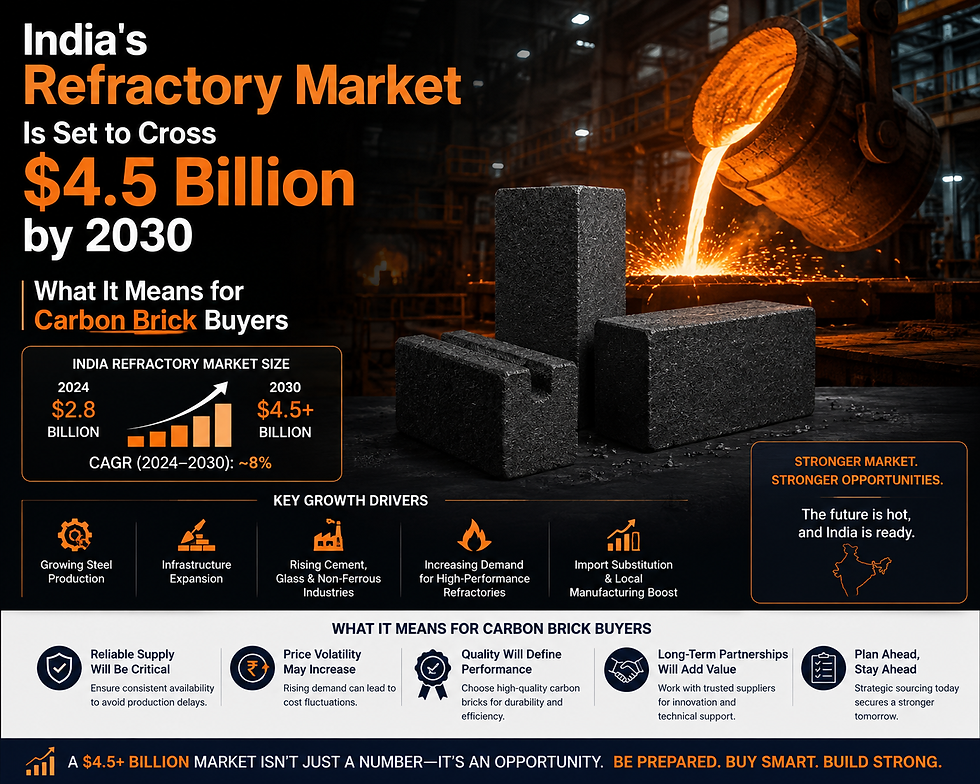
For chemical, fertiliser, and metal-processing plants, this expansion also raises a practical question: which lining material fits which part of the plant? Carbon bricks and magnesia carbon bricks serve different roles, and mixing them up on a project specification leads to premature lining failure. This article sets out the technical differences.
Globe Carbon Industries has manufactured carbon bricks at its Boisar, Tarapur MIDC facility near Mumbai since 1978, when the Times of India reported on the company's carbon brick manufacturing process — a first in India at the time. The company has since supplied carbon and magnesia carbon bricks to chemical, fertiliser, and steel plants in India and abroad, working to IS, ASTM, and DIN standards.
What Are Carbon Bricks?
Carbon bricks are pressed and baked from graded carbon and graphite raw material, bonded with a carbonaceous binder, and fired to develop mechanical strength. Unlike clay or concrete masonry, carbon bricks are chemically inert to most acids and alkalis and are non-wetting, meaning liquids do not readily penetrate or react with the brick surface.

Two properties make carbon bricks suitable for chemical-plant lining work:
Chemical inertness — carbon does not react with most acids, alkalis, solvents, or salt solutions, even at elevated concentrations.
Thermal shock resistance — carbon bricks tolerate rapid temperature swings without cracking, a common failure point for ceramic or ordinary refractory linings.
Carbon bricks are manufactured in two grades — impregnated and non-impregnated — and a related but distinct product, magnesia carbon bricks, is used for high-temperature furnace linings rather than chemical-resistant lining. The three are not interchangeable.
Impregnated carbon bricks are treated with a resin (typically phenolic) that fills the pore structure of the fired brick. This reduces porosity and water absorption substantially compared with the non-impregnated grade, and increases crushing and flexural strength.
Typical technical specifications:
Property | Value |
Density | 1.6 g/cc |
Compressive strength | 600 kg/cm² |
Flexural strength | 300 kg/cm² |
Tensile strength | 125 kg/cm² |
Porosity | 4% |
Water absorption | 2% |
Carbon content | 98% |
Ash content | 1.5% |
Thermal conductivity | 4–6 W/mK |
Maximum service temperature | 180°C |
Because of their low porosity, impregnated carbon bricks are specified where the lining must resist liquid penetration and where mechanical loads or abrasion are a factor — reaction vessels, acid storage tanks, and process towers handling nitric or hydrochloric acid solutions.
Non-impregnated carbon bricks are used as fired, without a resin treatment. This gives them higher porosity than the impregnated grade, but also a higher service-temperature rating, since there is no resin binder to break down under heat.
Typical technical specifications:
Property | Value |
Density | 1.5 g/cc |
Compressive strength | 350–400 kg/cm² |
Flexural strength | 100–150 kg/cm² |
Tensile strength | 60 kg/cm² |
Porosity | 18–24% |
Water absorption | 12–18% |
Carbon content | 99% |
Ash content | 1% |
Thermal conductivity | 4–6 W/mK |
Maximum service temperature | 750°C |
Non-impregnated carbon bricks are used where the operating temperature exceeds what a resin-impregnated brick can safely tolerate, such as furnace linings, flue ducts, and kiln sections, and in acid or alkali exposure where the higher absorption of this grade is not a limiting factor.
Magnesia carbon bricks are a separate category of refractory, built for steelmaking and non-ferrous smelting rather than chemical-plant lining. They are made from dead-burned or fused magnesia combined with graphite, bonded with a carbon-based resin rather than fired, and typically include antioxidants to protect the graphite content from oxidation at operating temperature.

Key properties:
High melting point — magnesia carbon bricks withstand temperatures up to approximately 2,800°C, suited to furnace and converter linings.
Slag resistance — the graphite content resists molten slag penetration and erosion, extending lining life.
Thermal shock resistance — the bricks withstand rapid heating and cooling cycles without spalling.
Lower modulus of elasticity — compared with fired basic refractories, magnesia carbon bricks flex slightly under stress rather than cracking.
Magnesia carbon bricks are used to line basic oxygen furnaces (BOF) and electric arc furnaces (EAF) in steelmaking, ladles, and converters, as well as furnaces in non-ferrous metal processing such as copper, lead, and ferrochrome smelting. Because carbon bricks and magnesia carbon bricks are often specified for the same plant — one for the acid-resistant sections, the other for the high-temperature metallurgical sections — buyers should confirm which product a given lining zone actually calls for before ordering.
Chemical Resistance of Carbon Bricks
Both grades of carbon brick tolerate a wide range of process chemicals. Approximate resistance limits, based on standard testing, are:
Nitric acid — up to 40%
Hydrofluoric acid — up to 40%
Hydrochloric acid — up to 35%
A mixed acid stream of 25% nitric acid, 10% hydrofluoric acid, and 65% water
Phosphoric acid — up to 75%
Sulphuric acid — up to 50%
Sodium hydroxide and potassium hydroxide — up to 50%
Carbon brick is one of the few lining materials rated for hydrofluoric and fluosilicic acid service, where most ceramic and acid-resistant clay linings fail.
Where These Bricks Are Used
Chemical process vessels — reactors, scrubbers, and storage tanks handling acids or alkalis (carbon bricks)
Acid towers and absorption columns — in sulphuric and nitric acid plants (carbon bricks)
Pickling and etching baths — in steel and metal-finishing plants (carbon bricks)
BOF and EAF furnace linings, ladles, and converters — in steelmaking (magnesia carbon bricks)
Non-ferrous smelting furnaces — copper, lead, and ferrochrome processing (magnesia carbon bricks)
Floor and trench lining — areas with routine acid or alkali spillage (carbon bricks)
Both product types are usually installed with a matching cement or mortar system, and joint width and mortar selection affect the lining's long-term performance as much as the brick itself.
Globe Carbon Industries: Manufacturer, Supplier, and Exporter
Globe Carbon Industries is a manufacturer, supplier, and exporter of impregnated carbon bricks, non-impregnated carbon bricks, and magnesia carbon bricks, based in Mumbai, Maharashtra. Products are manufactured to IS, ASTM, and DIN specifications, with in-house testing for compressive strength, water absorption, and dimensional accuracy before dispatch, and the company arranges delivery to project sites in India and internationally.
Customers who have used the company's carbon bricks and cements include units of Rashtriya Chemicals & Fertilizers, Steel Authority of India, Deepak Fertilizers & Petrochemicals, and Paradeep Phosphates, among other process industry plants.
For a specific project, the brick grade, thickness, and jointing cement should be selected based on the chemical exposure, operating temperature, and mechanical load the lining will face. Our technical team reviews these details before recommending a specification.
Frequently Asked Questions
What is the difference between carbon bricks and magnesia carbon bricks?
Carbon bricks are made from carbon and graphite raw material and are used mainly for chemical resistance in acid and alkali environments, at temperatures up to 750°C. Magnesia carbon bricks combine magnesia with graphite and are used for furnace and converter linings in steelmaking and non-ferrous smelting, withstanding temperatures up to approximately 2,800°C.
Which carbon brick grade should I use for a high-temperature lining versus an acid storage tank?
Non-impregnated carbon bricks are generally specified for higher-temperature applications, since they have no resin binder to break down under heat. Impregnated carbon bricks are better suited to acid storage tanks and vessels where low water absorption and higher mechanical strength matter more than maximum temperature rating.
Does Globe Carbon Industries export carbon bricks and magnesia carbon bricks outside India?
Yes. Globe Carbon Industries manufactures, supplies, and exports these products from its Mumbai-based facility to customers in India and internationally, with delivery arranged to project sites worldwide.


