7 Signs Your Graphite Heat Exchanger Needs Maintenance or Replacement
Graphite heat exchangers are widely used in chemical processing, fertilizer, steel, pharmaceutical and other industries where highly corrosive liquids and vapours must be heated, cooled or condensed.
Their excellent chemical resistance and thermal conductivity make them particularly suitable for demanding process conditions. However, even a well-designed Graphite Heat Exchanger requires proper operation, periodic inspection and preventive maintenance. Ignoring early warning signs can eventually lead to reduced heat-transfer efficiency, unplanned shutdowns, leakage and higher operating costs.
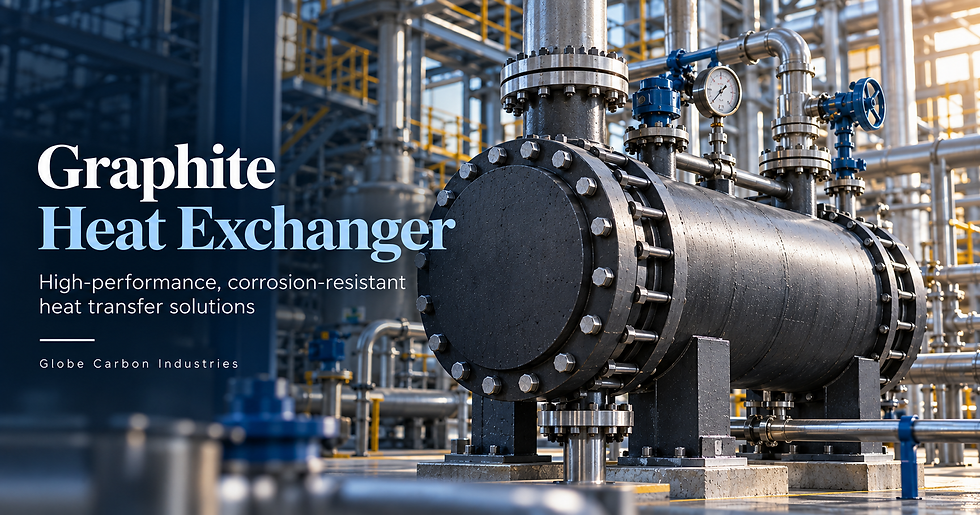
Here are seven important signs that your graphite heat exchanger may require maintenance, repair or replacement.
1. Reduced Heat Transfer Efficiency
One of the earliest indications of a problem is a noticeable reduction in heating or cooling performance. For example, the process fluid may no longer reach the required outlet temperature, or the exchanger may take longer than usual to achieve the desired temperature. This loss of performance can occur because deposits, scaling or process contaminants accumulate inside the flow passages. These deposits create an additional barrier between the fluids and reduce efficient heat transfer. If operating conditions such as flow rate and inlet temperature have not changed but thermal performance continues to decline, the exchanger should be inspected. Regular monitoring of inlet and outlet temperatures can help identify performance deterioration before it causes production problems.
2. Increasing Pressure Drop
A gradual increase in pressure drop across the graphite heat exchanger is another common warning sign. Deposits or blockages inside the process channels can restrict fluid flow. As the available flow area becomes smaller, pumps must work harder to maintain the required flow rate.
Operators may notice:
Increasing pump pressure
Lower process flow
Higher energy consumption
Difficulty maintaining production capacity
A combination of increasing pressure drop and decreasing thermal efficiency often indicates that the exchanger requires cleaning or inspection. Addressing fouling at an early stage is generally easier than allowing deposits to continue accumulating.
3. Visible Leakage Around the Heat Exchanger
Any unexplained leakage around a graphite heat exchanger should be investigated promptly. Graphite equipment is commonly selected because of its excellent resistance to corrosive chemicals. However, leakage can develop due to damaged seals, joints, graphite components or stresses created by abnormal operating conditions. Leaks should never simply be treated as routine maintenance issues, particularly when aggressive chemicals are involved. If the exchanger forms part of a wider corrosive process system, it may also be useful to inspect related graphite products and corrosion-resistant equipment to ensure the overall system is operating properly. Repeated leakage after previous repairs may indicate that replacement should be considered.
4. Process Fluid Contamination
A more serious warning sign is unexpected contamination between the process and service fluids. For example, cooling water may show traces of the chemical being processed, or the process stream may become contaminated with utility fluid.
This can indicate an internal leak or damage that allows fluids that should remain separated to mix. Because a heat exchanger is designed to transfer heat without allowing direct contact between the two fluid streams, cross-contamination requires immediate investigation. If internal leakage is suspected, the exchanger should be isolated and professionally inspected before being returned to service.
5. Frequent Cleaning Is Required
Most industrial heat exchangers require periodic cleaning. However, if cleaning becomes necessary far more frequently than before, the operating conditions should be evaluated.
Repeated fouling may be caused by:
Suspended solids in the process
Crystallization or precipitation
Chemical deposits
Inadequate flow velocity
Changes in process conditions
Contamination entering the system
Frequent fouling can reduce production efficiency and increase maintenance-related downtime. In some applications, modifying the operating conditions or cleaning schedule may solve the problem. In others, the existing exchanger may no longer be properly suited to the process requirements.
6. Cracks, Mechanical Damage or Signs of Thermal Stress
Graphite offers excellent corrosion resistance, but graphite equipment must still be protected from excessive mechanical and thermal stresses. Sudden temperature changes, rapid start-ups, pressure surges or operation beyond the original design conditions can place unnecessary stress on heat-exchanger components. During planned shutdowns, operators should inspect accessible areas for visible damage and review whether the exchanger has experienced unusual operating events. Repeated exposure to thermal shock or pressure fluctuations can shorten equipment life. Proper start-up and shutdown procedures therefore play an important role in maximizing equipment service life.
7. Maintenance Costs and Downtime Keep Increasing
Not every problem means that an exchanger should immediately be replaced. Many graphite heat exchangers can be cleaned, repaired, refurbished or have individual components replaced. However, there eventually comes a point where repeated repairs become less economical than installing a new exchanger.
Consider replacement when:
Leakage repeatedly returns after repairs
Thermal performance cannot be restored
Several internal components are damaged
Maintenance shutdowns are becoming increasingly frequent
Production losses exceed reasonable repair costs
Process conditions have changed significantly from the original design
The decision should be based on the overall equipment condition, operating requirements, safety considerations and total lifecycle cost rather than equipment age alone.
Maintenance or Replacement: How Should You Decide?
There is no fixed service life that applies to every graphite heat exchanger. Equipment operating under stable process conditions with proper preventive maintenance can remain reliable for many years. On the other hand, aggressive operating cycles, excessive fouling, thermal shock, pressure surges or unsuitable process conditions may lead to earlier deterioration.
Plant operators should therefore monitor important parameters such as:
Inlet and outlet temperatures
Pressure drop
Fluid flow rate
Leakage
Cleaning frequency
Changes in production capacity
Maintaining operating records makes it easier to identify gradual changes in exchanger performance and decide whether maintenance, repair or replacement is the most economical option.
Need a Graphite Heat Exchanger for Your Process?
Globe Carbon Industries manufactures and supplies graphite heat exchangers for demanding industrial applications involving corrosive liquids, vapours, acids, alkalies, mixtures and solvents. Our heat exchangers can be selected according to process requirements for cooling, heating, condensation and heat transfer between corrosive fluids. If your existing heat exchanger is showing reduced performance, recurring leakage or increasing maintenance requirements—or you are planning a new installation—our team can help evaluate your application and recommend a suitable solution.
Request a Technical Consultation or Quote
Contact Globe Carbon Industries with details such as the process fluid, operating temperature, flow rate and application. Our team can assist you in selecting a suitable graphite heat exchanger for your industrial process.
Frequently Asked Questions
1. How often should a graphite heat exchanger be inspected?
There is no universal inspection interval because it depends on the process fluid, operating temperature, pressure, fouling tendency and duty cycle. Operators should monitor performance continuously and include the exchanger in the plant's preventive maintenance and planned shutdown inspection program.
2. Can a graphite heat exchanger be repaired instead of replaced?
Yes. Depending on the exchanger design and extent of damage, cleaning, leak repair, component replacement or refurbishment may be possible. Replacement becomes more appropriate when damage is extensive, performance cannot be restored or repeated repairs are causing excessive downtime.
3. What causes graphite heat exchanger performance to decrease?
Common causes include fouling, deposits, blocked passages, incorrect flow conditions and operation outside the intended design parameters. Sudden temperature or pressure changes can also contribute to equipment stress. Regular monitoring and preventive maintenance can help detect these issues early.